How Much Does It Cost to Freeze Your Eggs? A Complete Guide
Quick Answer
The total cost to freeze your eggs typically ranges from $5,795 to a national average of $16,000 depending on the clinic, your medication protocol.
At CNY Fertility, egg freezing, including medications, monitoring, and one year of storage, runs $6,395, compared to a national average of around $16,800. Most patients also need to factor in annual storage fees and the future cost of IVF when they’re ready to use their eggs. Because most women need more than one retrieval cycle, the total investment across a complete egg-freezing journey can range from $11,000 to $32,000 or more, depending on age and goals.

Why Egg Freezing Costs Vary So Much
Egg-freezing costs vary widely depending on where you look. That’s because egg freezing isn’t a single flat fee. It’s a process made up of several distinct phases, each billed separately, often by different providers.
Understanding what each phase costs and what drives variation within each phase is the key to realistic planning.
There are three main cost categories to understand:
- The egg freezing procedure itself — what the clinic charges for monitoring, egg retrieval, and cryopreservation
- Medications — paid directly to a pharmacy, not your clinic
- Ongoing storage fees — the annual cost to keep your eggs frozen
When you eventually use your frozen eggs to try to conceive, you’ll encounter a fourth category: the cost of IVF. We cover all of these below.
Cost Overview: CNY Fertility vs. National Average
| Cost Component | National Average | CNY Fertility |
|---|---|---|
| Egg freezing cycle (procedure only) | $11,000 | $2,999 |
| Medications | ~$4,000 | ~$1,800 |
| Monitoring | $2,000 | $995 in house |
| Full cycle estimate (procedure + meds + monitoring) | $16,000 | $5,795 |
| Annual storage | $800 | $600 |
| Frozen egg IVF (when ready to use eggs) | $12,000 | $5,140 |
| Frozen embryo transfer (if needed) | $6,000 | $1,940 |
Prices reflect self-pay estimates and national averages sourced from internal research, FertilityIQ, and ASRM. Individual costs vary based on medication protocol, number of embryos tested, and treatment specifics. Pricing is subject to change.
Egg Freezing Cost Calculator
The cost calculator below for egg freezing includes the basics and add-ons like monitoring and medications for both CNY and the national average.
{{ treatments[treatment_selected]['data']['footnote'] }}
The above calculation is for simulation purposes only. It is reflective of self-pay pricing, includes highly variable estimates paid to CNY and third parties, and national averages obtained through internal research, FertilityIQ, ASRM, and Resolve. Billing through insurance will likely result in substantially different fees. CNY Fertility does not warrant or guarantee any price for services conducted or rendered by a third party and recommends everyone obtain written estimates from any medical facility involved in your treatment as well as verification of coverage from your insurance company prior to beginning treatment.
1 USD = {{currency.rates[currentCurrency]}} {{currentCurrency}} The procedure cost covers everything your fertility clinic charges to stimulate your ovaries, retrieve your eggs, and freeze them. It does not include medications, which are billed separately by a pharmacy. Most fertility clinics either quote a single global fee or break the procedure into line items. Here’s what those line items typically include: Monitoring. During the ovarian stimulation phase, you’ll have multiple ultrasounds and blood draws to track follicle development and time your retrieval correctly. If you live near a CNY location, monitoring can be done in-house. If you’re traveling for your retrieval, monitoring is done at a local facility near you and is coordinated with CNY remotely for a $150 remote cycle management fee. Egg retrieval. The surgical procedure to collect eggs from your ovaries. Done under sedation, this takes about 20 minutes, and most patients return to normal activities within a day or two. Anesthesia. Included in most clinic fees, though worth confirming when comparing quotes. Cryopreservation. The vitrification process that flash-freezes your eggs in liquid nitrogen. Modern vitrification achieves survival rates well above 90% and is now the standard technique at reputable clinics.
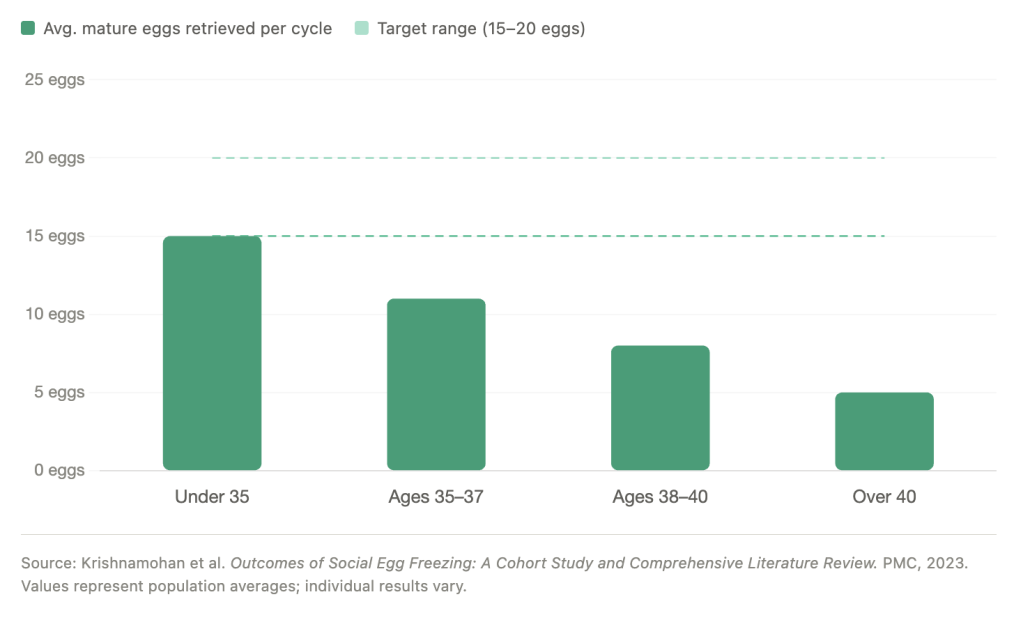
Medications are typically the second-largest cost in an egg freezing cycle, and they’re paid directly to a pharmacy rather than your clinic. That means they’re often excluded from the headline number a clinic quotes, which is part of why costs can look deceptively low at first glance. Stimulation medications encourage your ovaries to produce multiple eggs in a single cycle rather than the one egg your body naturally matures each month. The most common drugs used are gonadotropins (FSH and LH) along with supporting medications to prevent premature ovulation. Medication costs vary based on the protocol your doctor designs and the pharmacy you use. The national average for stimulation medications is around $4,000 per cycle. At CNY Fertility, we’ve negotiated substantially better pricing with fertility pharmacies. Most CNY patients pay around $1,900 for a standard stimulation protocol, though this varies based on individual response and dosing adjustments. If you’re prescribed a lower-stimulation protocol, medications will cost less. If you require higher doses due to diminished ovarian reserve or other factors, costs can be higher. Once your eggs are frozen, they need to be stored in liquid nitrogen in specialized cryogenic tanks. Storage fees are charged annually or monthly and are ongoing until you decide to use your eggs or discontinue storage. The national average for storage is around $800 per year. At CNY Fertility, annual storage runs approximately $600. Most clinics include a period of complimentary storage (typically 6 to 12 months) in the initial cycle fee. Because egg freezing is often done with the intention of using the eggs years later, storage costs accumulate over time. Someone who freezes at 32 and uses their eggs at 38 will have paid roughly $4,000 in storage over that period at national average rates, or around $3,000 at CNY rates. One way to reduce long-term storage costs is to transfer your eggs to an off-site long-term storage facility after the initial period, which some clinics offer at a lower annual rate. This is the question that matters most for total cost planning, and it’s also the one most clinics are reluctant to answer directly because it depends on age and individual response. But the data tells a fairly clear story. The goal of egg freezing is to store enough mature eggs to give yourself a meaningful chance of a live birth when you’re ready to use them. Research suggests that approximately 15 to 20 mature eggs is a reasonable target for women under 38 hoping to have one child, though the exact number needed varies with age.
The challenge is that not every retrieval produces 15 to 20 mature eggs, particularly as age increases. Here’s how average egg yield per retrieval varies by age: FertilityIQ data suggests the average egg freezing patient completes more than one cycle, with over 20% completing three or more.
This is one of the most important pieces of planning information because it means the realistic total cost for many patients is two to three times the per-cycle cost, not one. At CNY Fertility, lower per-cycle pricing makes completing multiple retrievals significantly more accessible than it would be at average national pricing. A patient who does three cycles at CNY at $6,395 per cycle spends approximately $19,185 on the retrieval phase. At the national average of $16,800per cycle, the same three cycles would run $50,400. Understanding the “funnel” of egg freezing helps explain why the number of eggs stored matters so much and why banking more is generally better. Here’s a simplified version of what happens at each stage when eggs are eventually used: This is why freezing more eggs when you can is generally the wise strategy, even if it means completing an additional retrieval cycle. Egg freezing preserves your options. When you’re ready to try to conceive using your frozen eggs, you’ll go through the IVF process, which involves This is a separate cost from the freezing phase. The frozen egg IVF cycle includes: Medications to prepare the uterine lining are also usually needed and paid separately. At CNY Fertility, the frozen egg IVF procedure with monitoring and medications is $5,140. The national average for a comparable cycle runs approximately $13,200 If you have extra embryos after your first transfer, or if genetic testing is performed (which requires freezing all embryos before transfer), a frozen embryo transfer is the next step. FETs are simpler and less expensive than the initial IVF cycle. At CNY Fertility, an FET including medications and monitoring runs approximately $1,940, compared to a national average of around $7,200. Some patients choose to add preimplantation genetic testing (PGT-A) to screen embryos for chromosomal abnormalities before transfer. This adds cost but can improve the odds of a successful transfer per attempt and reduce miscarriage risk, particularly for patients over 35. At CNY Fertility, PGT-A adds approximately $3,545. Nationally, the same testing often runs $8,700. To make this concrete, here are three realistic planning scenarios based on common patient profiles. Scenario 1: 29-year-old, one cycle, good response. Procedure $2,999 + medications $1,800 + monitoring $995 + 5 years storage $3,000 = approximately $8,794 at CNY. National average equivalent: approximately $21,000 to $24,000. Scenario 2: 35-year-old, two cycles needed. Two cycles at $5,795 each + 5 years storage $3,000 = approximately $14,590 at CNY. National average equivalent: approximately $35,000 to $38,000. Scenario 3: 38-year-old, three cycles, adds PGT-A and FET when ready. Three cycles at $5,795 + storage $3,000 + IVF $5,140 + FET $1,940 + PGT-A $2,000 = approximately $29,465 at CNY. National average equivalent: approximately $65,000 to $75,000. These are estimates, not guarantees. Individual costs vary significantly based on medication response, number of eggs retrieved, and whether additional cycles are needed. Most insurance plans do not cover elective egg freezing. However, the landscape is changing in a few important ways worth checking. Employer benefits. A growing number of employers, particularly in technology, finance, and healthcare, now offer egg freezing as an employee benefit. Reviewing your benefits package carefully before starting is worth doing, as coverage can range from a partial subsidy to full coverage of one or more cycles. State mandates for medically necessary preservation. A number of states mandate coverage for fertility preservation when it is medically necessary, such as before cancer treatment or another condition that could affect fertility. States currently including some form of medically necessary fertility preservation mandate include California, Connecticut, Delaware, Illinois, Maryland, New Hampshire, New Jersey, New York, and Rhode Island, though specific coverage terms vary.
Always verify directly with your insurer. Diagnostic testing. Even when the egg freezing procedure is not covered, initial consultations and diagnostic testing such as ovarian reserve testing are more commonly covered under standard health insurance. It’s worth checking what applies to your plan before your first appointment. For most patients, egg freezing is an out-of-pocket expense, and financing is a practical part of planning. CNY in-house financing. CNY Fertility offers in-house financing with no credit check and a 100% approval rate. Patients can finance their treatment for up to 36 months with a portion due upfront before starting. In-house financing applies to costs paid directly to CNY and cannot be used for third-party costs like medications. Fertility financing companies. Companies such as CapexMD, Future Family, and LendingClub partner with fertility clinics to offer financing that can often be applied to medications and other third-party costs in addition to clinic fees. These options require a credit check and vary in rates. Credit unions and personal loans. Credit unions often offer competitive personal loan rates and can be a strong option for patients with good credit who want to borrow across the full cost of a cycle including medications and storage. HSA and FSA accounts. Health Savings Accounts and Flexible Spending Accounts can be used for medically qualifying fertility treatment expenses, which may include portions of egg freezing. Check with your account administrator for specifics. It’s worth considering the other side of the equation. For many patients, the question isn’t just “can I afford to freeze my eggs?” but “can I afford not to?” Egg quality and quantity decline with age, and patients who wait and then struggle to conceive often face multiple rounds of IVF using their own eggs, or the significantly higher cost of donor egg IVF. The national average cost of an IVF cycle is approximately $19,000 to $25,000, and many patients need more than one attempt. Donor egg IVF averages $25,000 to $40,000 per cycle. For patients in their early to mid-30s who know they want children in the future, the math often favors acting sooner rather than later, both biologically and financially. The egg-freezing procedure at CNY costs $2,999. A full cycle, including medications and monitoring, typically runs approximately $5,795, compared to a national average of around $16,000. Annual storage is approximately $600. No. Medications are paid directly to a pharmacy and are separate from clinic fees. At CNY Fertility, medications for a standard stimulation protocol run approximately $1,900, compared to a national average of around $4,000. It depends on your age, ovarian reserve, and how many eggs you retrieve per cycle. Younger patients with good ovarian reserve often reach their storage goals in one or two cycles. Patients in their late 30s commonly need two to three cycles. Your care team can give you a more personalized estimate based on your AMH and antral follicle count. When you’re ready to use your frozen eggs, you’ll go through IVF. At CNY Fertility, frozen egg IVF runs approximately $5,140. A frozen embryo transfer, if needed, runs approximately $1,940, including medications and monitoring. Nationally, these procedures average $13,200 and $7,200 respectively. Most insurance plans do not cover elective egg freezing. However, employer benefits increasingly include egg freezing coverage, and some states mandate coverage when egg freezing is medically necessary. Always verify directly with your insurer and employer benefits administrator. CNY Fertility offers in-house financing with no credit check and 100% approval for up to 36 months. Third-party fertility financing companies, credit unions, personal loans, and HSA/FSA accounts are also options depending on your situation. Eggs can be stored indefinitely in liquid nitrogen without a meaningful decline in quality, provided storage conditions are properly maintained. Healthy pregnancies have resulted from eggs stored for more than a decade. The cost to freeze your eggs depends on how many cycles you need, which clinic you choose, and your medication protocol. At CNY Fertility, a complete egg-freezing cycle costs approximately $5,795, compared to a national average of around $16,000. This means patients completing multiple cycles can save tens of thousands of dollars compared to higher-cost clinics. The most important planning steps are getting your ovarian reserve tested early so you know what to expect from each retrieval and budgeting realistically for the possibility of multiple cycles. For most patients, freezing eggs sooner rather than later is both biologically and financially the smarter decision. If you have questions about costs, financing, or whether egg freezing makes sense for your situation, our team is here to help. Reach out to schedule a consultation, and we’ll walk through your specific situation. For IVF Grant Announcements, Fertility News and More!Automatically Included
Sample Payment Calculator: Self Pay Pricing
National Average
{{ this.treatment_price_others|toCurrency}}
Estimated 3rd Party Costs {{total.third_party| toCurrency}}
Grand Total {{(total.total + total.third_party)| toCurrency}}
National Average: {{total.national|toCurrency}}
Last Update {{currency.last_update}}The Cost of the Egg Freezing Procedure
The Cost of Egg Freezing Medications
Egg Freezing Storage Costs
How Many Egg Freezing Cycles Will You Need?
Also Important: Not All Retrieved Eggs Become Babies
The Future Cost: Using Your Frozen Eggs
Frozen Egg IVF Cost
Frozen Embryo Transfer (FET) Cost
Optional: Genetic Testing
Total Cost Scenarios
Does Insurance Cover Egg Freezing?
Egg Freezing Financing Options
The Cost of Not Freezing Your Eggs
Frequently Asked Questions
How much does it cost to freeze your eggs at CNY Fertility?
Does the cost of egg freezing include medications?
How many egg freezing cycles will I need?
How much does it cost to use frozen eggs later?
Is egg freezing covered by insurance?
What financing options are available for egg freezing?
How long can eggs be stored?
The Bottom Line
Article Sources