Donor Egg Cost: How Much Donor Eggs & Donor Egg IVF Cost

Quick Answer: How Much Do Donor Eggs Cost?
The average cost of donor egg IVF in the United States is around $25,000–$45,000 per cycle. Lower-cost programs may start around $11,500–$15,000, while agency-coordinated donor cycles can exceed $50,000 once donor compensation, IVF procedures, medications, and genetic testing are included.
The total cost includes both donor eggs and the IVF treatment required to fertilize the embryos and perform the embryo transfer.
In this guide, we’ll explain:
- The average egg donor cost
- What affects the cost of donor egg IVF
- Why prices vary between clinics
- Ways that many patients can reduce treatment costs
Donor Egg IVF Cost Snapshot
| Scenario | Typical Cost |
|---|---|
| CNY Donor Egg IVF Program, including medications, monitoring, and 4 eggs | $11,295 |
| Average U.S. donor egg IVF | $39,000 |
| Agency-based donor egg cycles | ~$35,000–$55,000 |
| Average cost per live birth | ~$72,642 |
According to a prospective cohort study, the median cost of donor egg IVF was about $39,000, and the average cost per live birth was estimated at $72,642 when multiple cycles were required.

What Is Donor Egg IVF?
Donor egg IVF is a fertility treatment similar to standard IVF, except the eggs used to create embryos come from another woman.
The intended parent carries the pregnancy, but the egg used for fertilization is donated.
Why Are Donor Eggs Used?
Donor eggs may be recommended for several reasons, including:
- diminished ovarian reserve
- age-related fertility decline
- genetic conditions
- prior failed IVF cycles
- cancer survivors who did not freeze eggs
- same-sex male couples
- single intended parents
What Types of Donor Eggs Are Available?
Donor eggs are usually categorized in several ways.
Fresh vs Frozen Donor Eggs
Frozen donor eggs are already cryopreserved and stored in liquid nitrogen. They can be purchased from egg banks or fertility clinics and shipped for IVF.
Fresh donor eggs require a donor to complete an egg retrieval cycle after being selected by the intended parents.
Fresh cycles require more coordination and are usually more expensive.
Anonymous vs Non-Anonymous Donors
Anonymous donors do not have their identity disclosed to recipients or the future child.
Non-anonymous donors agree that identifying information may be shared.
Recipients typically have access to donor details such as:
- ethnicity
- education
- medical history
- physical characteristics
- childhood photos
Known Donors
Known donors are often friends or family members of the intended parent.
Even when using a known donor, IVF procedures must still be performed at a fertility clinic.
Where Can Donor Eggs Be Purchased?
Donor eggs are typically obtained through three types of organizations.
Fertility Clinics
Many fertility clinics operate their own donor egg programs offering both fresh and frozen eggs.
Donor Egg Banks
Egg banks specialize in frozen donor eggs that can be shipped to fertility clinics.
Donor Egg Agencies
Agencies coordinate fresh donor cycles using donors recruited across the country.
Donor Egg IVF Cost Breakdown
| Cost Component | Typical Price |
|---|---|
| Donor egg compensation | $5,000–$10,000 |
| Donor screening and testing | $3,000–$6,000 |
| Donor medications | $3,000–$6,000 |
| Egg retrieval procedure | $5,000–$10,000 |
| IVF fertilization and lab work | $5,000–$15,000 |
| Embryo transfer | $3,000–$5,000 |
| Total typical cost | ~$25,000–$45,000 |
Because donor egg IVF involves both the donor’s medical cycle and the recipient’s IVF treatment, costs accumulate across multiple components.
How Much Does IVF With Donor Eggs Cost?
The total cost of IVF with donor eggs averages $39,000 and typically ranges from $25,000 to $45,000 in the United States, depending on the clinic and treatment structure.
Lower-cost donor egg IVF programs like CNY Fertility’s start closer to $11,500–$15,000, while agency-coordinated cycles can exceed $50,000.
Donor Egg Cost by Program Type
| Program Type | Typical Cost | Notes |
|---|---|---|
| Fertility clinic donor programs | $25,000–$45,000 | Eggs and IVF handled in one clinic |
| Frozen egg banks | $25,000–$35,000 | Eggs purchased separately then shipped |
| Donor egg agencies | $35,000–$55,000 | Fresh donor cycles coordinated externally |
| CNY Fertility | $11,295 (4 eggs)-$14,295 (6 eggs) | Fresh or Frozen |
Fresh vs Frozen Donor Egg Cost
Fresh donor eggs generally cost more because they require:
- donor stimulation medications
- egg retrieval surgery
- cycle synchronization
- more coordination between donor and recipient
Frozen eggs are already retrieved and stored, reducing coordination and lowering costs.
How Much Does One Donor Egg Cost?
Donor eggs are usually purchased in groups rather than individually.
Frozen egg banks commonly sell 6–8 eggs per lot, typically costing $15,000–$20,000 before IVF fees.
This means the approximate cost per donor egg is around $2,000–$3,000, although the number required depends on embryo development and treatment success.
Why Are Donor Eggs So Expensive?
Donor egg IVF costs are high for two main reasons.
First, IVF itself averages around $20,000 per cycle in the United States.
Second, egg donors must be compensated for:
- medical screening
- fertility medications
- undergoing egg retrieval surgery
- time commitment and travel
These factors add several thousand dollars to the overall treatment cost.
What About Insurance Coverage?
Insurance rarely covers donor egg IVF.
According to internal CNY Fertility data, less than 1% of patients have insurance coverage for donor egg IVF.
As a result, most patients pay out-of-pocket for treatment.
Cost to Have a Baby With Donor Eggs
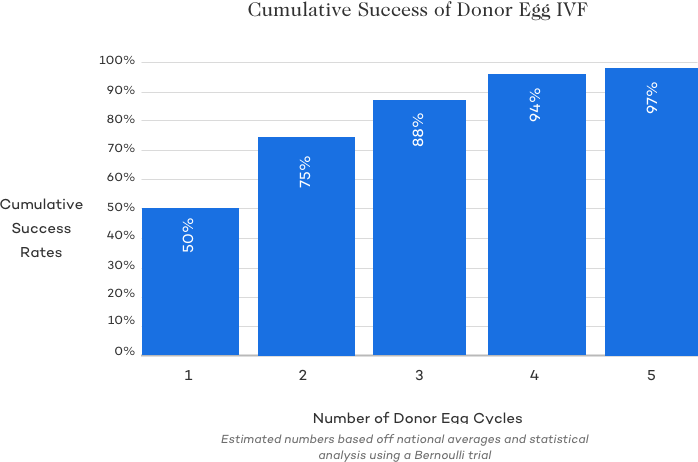
Even though donor egg IVF has among the highest success rates in fertility treatment, multiple cycles may still be needed.
Because of this, the total cost to achieve a live birth can exceed the cost of a single cycle.
One study estimated an average cost per live birth of about $72,642 when multiple treatment attempts were required.
Is Donor Egg IVF Worth the Cost?
Although donor egg IVF can be expensive, it also offers some of the highest success rates in fertility treatment.
Success rates depend primarily on the age of the egg donor rather than the age of the recipient. Because donors are typically in their 20s or early 30s, donor egg IVF often produces higher pregnancy rates than IVF using a patient’s own eggs at older ages.
For many patients with diminished ovarian reserve or repeated IVF failure, donor egg IVF may provide the highest probability of pregnancy per cycle.
Because of this, donor egg IVF can sometimes lead to a lower cost per live birth compared with multiple unsuccessful IVF cycles using a patient’s own eggs.
Donor Egg Financing Options
Because donor egg IVF is expensive, many patients explore financing options.
Fertility Financing Specialists
Some fertility clinics partner with lenders specializing in fertility treatment financing.
Traditional Lending Options
Other patients use:
- personal loans
- HELOC loans
- credit cards
- crowdfunding
Each option carries different credit requirements and interest rates.
FAQ: Egg Donor Cost
How much do donor eggs cost?
Donor egg IVF typically costs $25,000 to $45,000 per cycle in the United States, though lower-cost programs may can start around $12,000
How much does IVF with donor eggs cost?
IVF with donor eggs usually costs $25,000–$45,000, including donor compensation, IVF laboratory procedures, and embryo transfer.
Why are donor eggs so expensive?
Donor egg IVF involves donor screening, fertility medications, egg retrieval surgery, and IVF laboratory procedures, which significantly increase treatment costs.
How much does it cost to be an egg donor?
Egg donors typically receive $5,000–$10,000 in compensation, depending on the clinic and donor program.
The Bottom Line
Donor egg IVF is one of the most effective fertility treatments, but it also comes with significant financial considerations.
In the United States, donor egg IVF typically costs between $25,000 and $45,000 per cycle, though lower-cost programs may offer treatment starting near $10,000.
Because insurance coverage is uncommon and multiple cycles may be required, understanding the full cost breakdown can help intended parents make informed decisions about their fertility journey.