Age and Fertility: How Fertility and Treatment Options Change Over Time

Age is one of the most critical factors influencing fertility, particularly in females. While many people know that fertility changes with age, fewer understand why those changes happen or how modern fertility treatment can help support family building later in the reproductive lifespan.
This article explains how age affects fertility in females, what happens to egg quantity and quality over time, how male fertility also changes with age, and what options exist at different life stages.
Age and Fertility in Females: The Big Picture
When people discuss age and fertility, age itself is not the primary problem. The underlying issue is egg quantity and egg quality.
Females are born with a finite number of eggs. Over time, that supply declines, and the remaining eggs are more likely to have chromosomal abnormalities. These changes directly affect fertilization, embryo development, implantation, and miscarriage risk.

Why Female Fertility Declines With Age
Eggs are formed before birth and remain dormant for decades. Over time, they are exposed to oxidative stress, environmental factors, and normal cellular aging.
As a result
- Fewer eggs remain in the ovaries
- A higher proportion of eggs are chromosomally abnormal
- Embryo development becomes less predictable
- Miscarriage risk increases
These changes accelerate after the mid-30s and become more pronounced in the early 40s.
Age and Fertility Chart
The chart below reflects general population trends, not individual outcomes.
Female Fertility by Age (General Trends)
| Age Range | Fertility Pattern |
|---|---|
| Under 30 | Highest egg quality and lowest miscarriage risk |
| 30–34 | Mild decline, strong response to treatment |
| 35–37 | Noticeable egg quality decline, IVF is often effective |
| 38–40 | Faster decline, higher aneuploidy rates |
| 41–42 | Lower success with own eggs, individualized outcomes |
| Over 43 | Very low success with own eggs, donor eggs are often discussed |
These trends reflect egg quality, not uterine health. Many people in their 40s can still carry healthy pregnancies with appropriate support.
Chances of Getting Pregnant By Age Chart
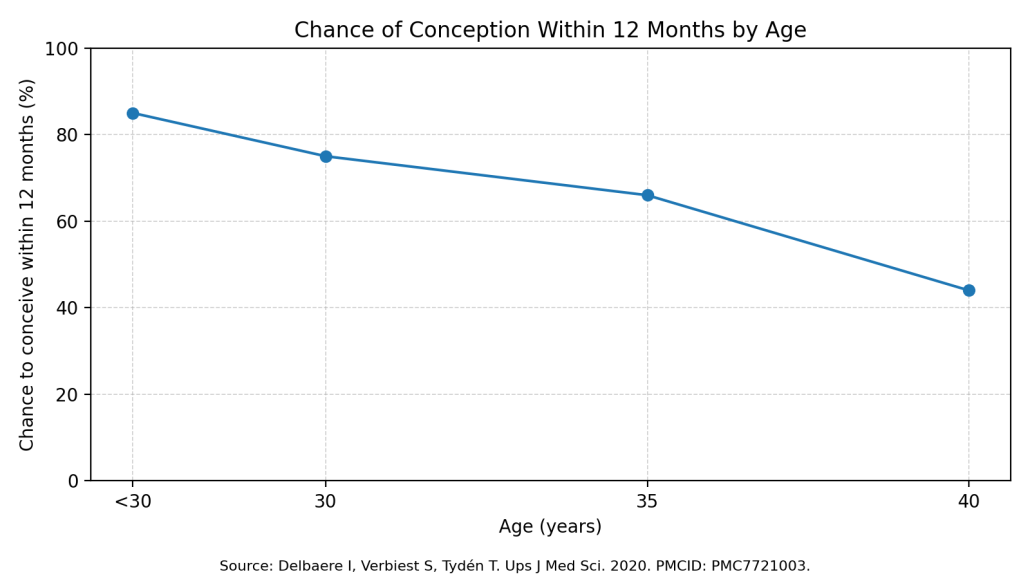
The chart below shows the estimated chance of conceiving naturally within 12 months based on female age.
These figures reflect population-level trends, not individual outcomes, and are based on regular unprotected intercourse without known infertility issues.
Many people outside these averages conceive sooner or later than expected, and fertility testing or treatment can significantly alter individual outcomes.
| Age | Chance of Conceiving Within 12 Months |
|---|---|
| Under 30 | 85% |
| 30 | 75% |
| 35 | 66% |
| 40 | 44% |

Fertility and Age: What Testing Can and Cannot Tell You
Fertility testing can provide useful information about how the ovaries are functioning, but it does not directly measure egg quality or predict whether pregnancy will occur in a given cycle. These tests are best understood as tools for guiding planning and treatment.
Common fertility tests include
- AMH (anti-Müllerian hormone), which reflects the size of the remaining egg pool
- Day-3 FSH and estradiol, which indicate how hard the body must work to stimulate the ovaries
- Antral follicle count (AFC), which estimates the number of follicles visible on ultrasound at the start of a cycle
These tests can be used to estimate ovarian reserve, but not the genetic health of eggs.
Fertility and Age: What This Means at Different Life Stages
CNY Fertility does not believe age alone should determine access to care. Age informs counseling and risk assessment, but decisions about undertaking assisted reproductive treatments are made collaboratively.
-
Under 30: Fertility is typically high. IVF may still be appropriate for medical indications or fertility preservation.
-
Ages 30–34: Gradual fertility decline begins. IVF success remains strong. Egg freezing can preserve future options.
-
Ages 35–37: Egg quality decline becomes more apparent. IVF is often recommended earlier.
-
Ages 38–40: Fertility decline accelerates. IVF with individualized protocols is commonly the most effective approach.
-
Ages 41–42: Pregnancy with one’s own eggs is still possible but less predictable. Many patients choose to try IVF with their own eggs before considering donor eggs.
-
Over 43: Success with own eggs becomes uncommon, but donor eggs or previously frozen eggs dramatically improve outcomes. CNY does not deny care based on age alone.
Male Fertility and Age: Does Age Matter for Men?
Male fertility also changes with age, though more gradually than female fertility.
With increasing male age
- Sperm DNA fragmentation increases, reflecting greater damage to genetic material, which may affect embryo development and increase the time to pregnancy
- Sperm motility and morphology may decline, reducing the likelihood of successful fertilization, particularly in natural conception
- Time to pregnancy may increase, especially when combined with advancing female age or other fertility factors
- Certain genetic and neurodevelopmental risks rise slightly, including small increases in conditions linked to de novo genetic mutations
Male Fertility and Age Chart
Male Fertility by Age (General Trends)
| Male Age | Typical Changes |
|---|---|
| Under 35 | Optimal sperm quality |
| 35–44 | Gradual increase in DNA fragmentation |
| 45–54 | Lower motility, longer time to pregnancy |
| Over 55 | Higher genetic and pregnancy risks |
Male age rarely prevents conception on its own, but it can influence outcomes, especially when combined with female age factors.
Age, Fertility, and IVF Outcomes
IVF success declines with age primarily because chromosomally abnormal embryos become more common.
When chromosomally normal embryos are available, implantation and live birth rates are similar regardless of age, highlighting that egg quality is the primary driver.
Fertility Treatment Options by Age
Modern fertility care offers multiple paths forward, and the most appropriate option often depends on age, ovarian reserve, and how quickly you desire to get pregnant.
In general
- IUI may be appropriate for younger patients with regular ovulation, good ovarian reserve, and minimal additional fertility factors, though success rates decline with age.
- IVF is often recommended as age increases or when younger patients want the fastest route to pregnancy. IVF allows the retrieval of multiple eggs in one cycle and better assessment of embryo development and quality.
- PGT-A may be used during IVF to identify chromosomally normal embryos, which can reduce miscarriage risk and improve implantation rates, particularly in patients over 35.
- Egg freezing and embryo freezing can preserve reproductive potential when done at younger ages. This may be especially valuable for those not ready to conceive but who want to protect future options. It’s also a standard practice for women who have health issues or who will undergo surgeries that can impact fertility.
- Donor eggs are often considered when egg quality becomes the primary factor impeding fertility. Donor eggs can restore high success rates even at later reproductive ages.
Because uterine function generally declines much more slowly than egg quality, many people in their 40s and beyond are still able to carry healthy pregnancies when using chromosomally healthy embryos, whether from donor eggs or previously frozen eggs.
Frequently Asked Questions About Age and Fertility
At what age does female fertility decline?
Female fertility begins to decline around age 30, with a steeper drop after age 35 due to declining egg quality.
Can you get pregnant naturally after 40?
Yes, but it becomes less likely. Many people over 40 conceive with IVF or donor eggs.
Is there an age limit for IVF?
There is no universal age limit. CNY Fertility does not deny treatment based on age alone.
Does male age affect fertility?
Yes. Male age can affect sperm quality and pregnancy outcomes, though changes are more gradual.
Do donor eggs overcome age-related infertility?
Yes. Donor eggs largely overcome age-related declines because success depends on egg quality, not uterine age.
Age and Fertility: The Takeaway
Age affects fertility primarily through changes in egg quantity and quality. While fertility declines over time, many people successfully build families later in life with the support of modern fertility treatment.
Earlier testing provides clarity, but age alone does not define possibility. Schedule a consultation with CNY Fertility to explore how their inclusive, individualized care can support you on your journey.