Phthalates and Fertility: What You Need to Know

Phthalates are chemicals used widely in plastics, cosmetics, and many everyday products. Over recent years, a growing body of research has raised concerns about how these substances may affect fertility.
In this article, we’ll help you understand their potential impact on fertility, so you can make informed choices on your path to parenthood.
What Are Phthalates?
Phthalates are industrial chemicals added to plastics to make them more flexible and durable.
They are also found in fragranced personal care items, medical tubing, household products, and even food packaging.
Because they are not tightly bound to the materials they’re added to, phthalates can leak into food, water, and air, creating widespread human exposure.
Phthalates belong to a group of endocrine-disrupting chemicals (EDCs). These compounds interfere with hormonal systems.
Hormones play a central role in reproduction, which makes phthalates of particular concern when it comes to fertility.
How Phthalates Affect Female Fertility
Research shows that phthalates may impact several aspects of ovarian and uterine health:
- Ovarian disruption: Studies show that phthalates can increase oxidative stress in ovarian tissue, disrupt follicle growth, and even lead to follicle death, all of which can compromise fertility.
- Impaired egg development: Phthalates can interfere with the normal cycle of egg growth in the ovaries. Normally, the body carefully regulates how eggs develop and mature, but phthalates may speed up the process of “recruiting” eggs before they’re ready, prevent eggs from fully maturing, and even block ovulation (the release of an egg). They can also cause eggs or follicles (the small sacs on the ovaries that contain the eggs) to break down and die off earlier than normal.
- Pregnancy outcomes: Some studies in humans suggest that higher phthalate exposure may make it more difficult to get pregnant and could increase the risk of early pregnancy loss.
How Phthalates Affect Male Fertility
Men are also at risk of phthalates impacting their fertility. Several studies link phthalate exposure to reduced sperm quality and hormonal disruption:
- Fertilization: For fertilization to occur, sperm must undergo processes called capacitation and the acrosome reaction. These processes prepare the sperm to penetrate the egg’s outer layer. Animal studies show that phthalates can impair these steps, which could reduce the chances of successful fertilization.
- Sperm quality: Human studies have found associations between phthalate exposure and reduced sperm motility (movement), abnormal morphology (shape), and lower sperm counts. These changes affect how efficiently sperm can reach and fertilize an egg.
- DNA integrity: Some evidence suggests that phthalates increase oxidative stress in sperm, which can lead to DNA fragmentation. Damaged DNA can compromise embryo development, even if fertilization occurs.
In short, phthalates may reduce both the quality and function of sperm, potentially lowering fertility and affecting pregnancy outcomes.
Evidence from Assisted Reproduction Studies
Higher levels of another phthalate metabolite called mono-(2-ethyl-5-hydroxyhexyl) phthalate (MHxP), were linked to a 92% lower chance of live birth. This highlights that phthalates don’t just affect early conception, but also the ability to carry a viable pregnancy.
Increased Risk of IVF Failure
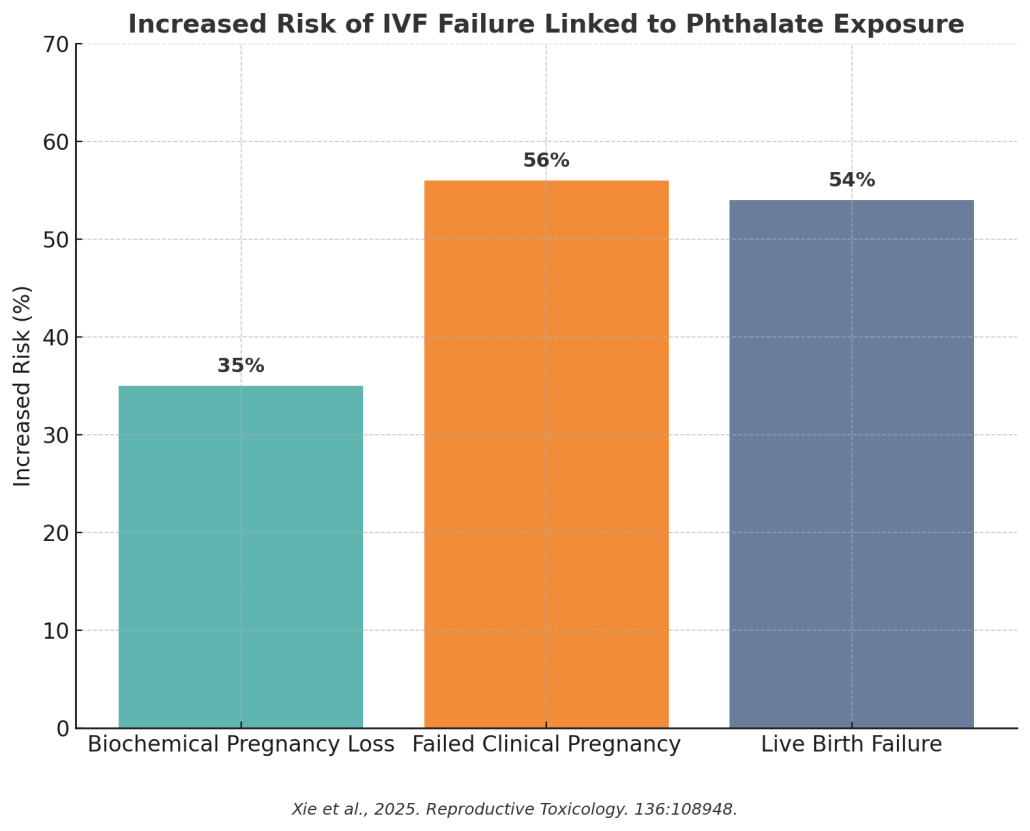
Systematic reviews of hundreds of studies have found that exposure to phthalates may cause :
- lower clinical pregnancy rates
- higher rates of pregnancy loss
- Lower overall live birth rates with IVF
What This Means for IVF Patients
In summary, phthalates can make it harder to get pregnant, increase the risk of early miscarriage, and reduce the likelihood of delivering a healthy baby through IVF.
5 Practical Ways to Reduce Phthalate Exposure
It is impossible to eliminate phthalates entirely, but small lifestyle changes can significantly reduce exposure:
- Choose whole foods over processed foods to minimize contact with plastic packaging.
- Store and heat food in glass, ceramic, or stainless steel rather than plastic containers.
- Select fragrance-free or phthalate-free cosmetics and personal care products, since phthalates are often hidden under the term “fragrance.”
- Avoid plastics labeled #3, #6, and #7, which are more likely to contain harmful additives.
- Replace everyday items over time by choosing lower-plastic options for things you use frequently, such as food storage containers, drinking bottles, and personal care products.
Phthalates and Fertility: The Takeaway
The research on how phthalates impact fertility is growing, and the evidence so far suggests that these chemicals can interfere with reproductive health in both women and men.
From ovarian disruption and altered sperm function to potential effects on IVF outcomes, phthalates are an environmental factor worth paying attention to.
While exposure is difficult to avoid entirely, being mindful of food storage, product selection, and personal care products can help reduce exposure risk and support reproductive health.